
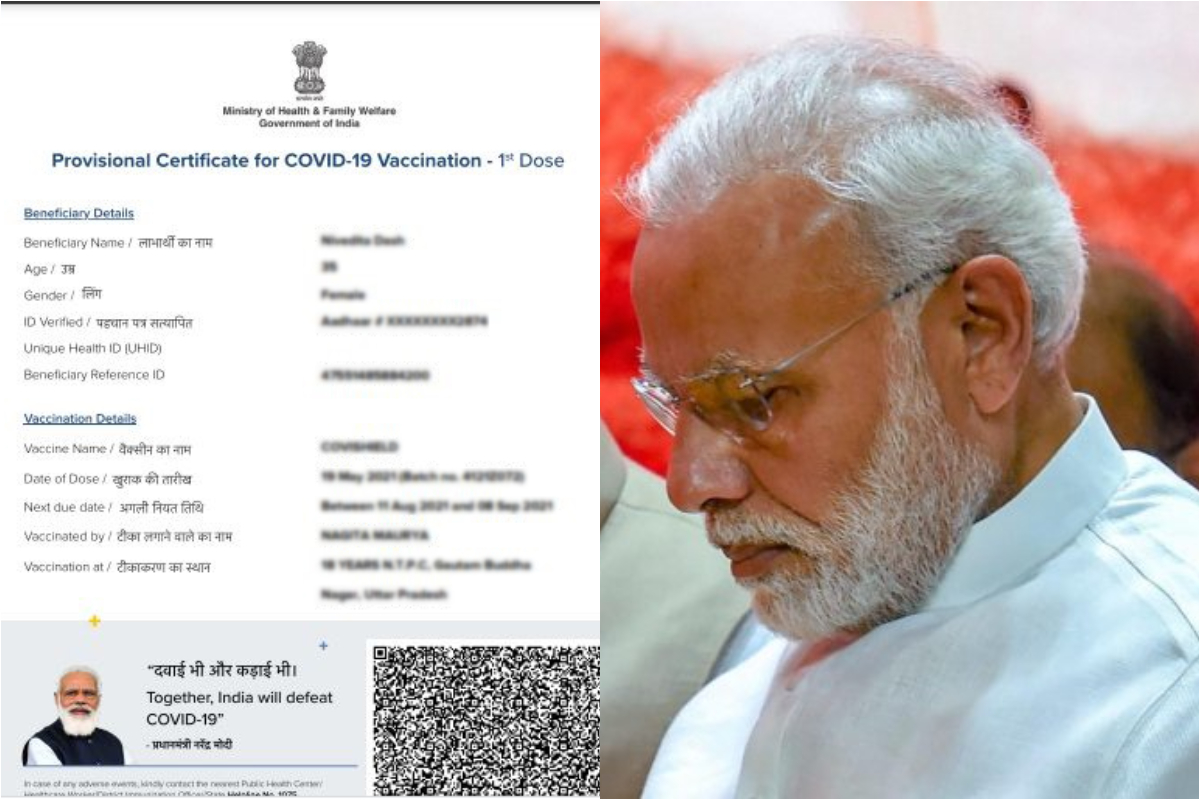
The Kerala High Court has called out the intolerance on behalf of the citizens in plea seeking removal of PM Modi's picture on Covid Certificates.
The Division Bench comprising of Chief Justice Arup Kumar Goswami and Justice N.K.Chandravanshi while dismissing an appeal challenging the rejection of the plea against Prime Minister's photograph being affixed on Covid-19 vaccination certificates, observed that an individual fundamental right is subservient to the larger public interest.
The petitioner has contended that the State has no right to access the private space in the certificate without the appellant consenting to it; and as a mandatory document, the Covid-19 Vaccination Certificate needs to be carried with the appellant, and therefore, the appellant is, in fact, a captive audience on whom unwanted speech in the form of the photograph and message is being imposed upon him. It was also contended that the appellant has the right to be left alone. That apart, it is submitted that messaging, and the general campaign associated with response to the Covid-19 pandemic, in which the Hon'ble prime Minister is permanently shown at public expense would lead to interference with appellant's rational thought and critical appraisal leading to a distortion of the appellant's right to vote including exercising free choice.
It was also contended that the public campaign so done violates the guidelines laid down by the Hon'ble Supreme Court in Common Cause v. Union of India [(2015) 7 SCC 1], wherein it was noted that “Government advertising shall maintain political neutrality and avoid glorification of political personalities and projecting a positive impression of the party in power”.
It was the prime contention of the appellant that the learned Single Judge didn't consider at all the question whether the Hon'ble Prime Minister's picture on the Covid-19 Vaccination Certificate was based on any law, policy, circular or decision of the Union of India. It was also contended that the learned Single Judge has not ascertained as to whether the Hon'ble Prime Minister himself had ordered to have his photograph in Covid-19 Vaccination Certificate, as is laid down by the Hon'ble Supreme Court in the Common Cause case (supra).
The question for consideration before the High Court was as to whether the photographic printing of the Hon'ble Prime Minister in the Covid-19 Vaccination Certificate issued to the vaccinated persons online through Co-WIN platform , violates the fundamental right guaranteed to the petitioner conferred under Part III of the Constitution of India, especially Article 19(1)(a) dealing with freedom of speech and expression.
The Court at the outset opined that the printing of a photograph, or inscriptions contained in the certificate would not interfere with the fundamental rights of appellant since the photograph and the inscriptions are made apparently with the intention of gathering the attention of the citizens at large and to motivate the citizens to come forward for the administration of the vaccine.
"such an action was required from the side of the Government of India since Covid-19 vaccination was not made compulsory and therefore, in order to protect the larger interest of the community as such, motivation in order to instill confidence in the public, was largely required. Printing of the photograph of the Prime Minister and the inscriptions in the Certificate were not the only methods adopted by the Government of India in order to win confidence of the public so as to ensure that the citizens are undertaking the administration of vaccine; rather press releases were also given by the concerned ministry, apart from advertising and other awareness programmes so as to achieve the target of acquiring herd immunity in the larger interest of the citizens and the country."
The Court further noted that once an elected body comes to power in the Parliament, with the mandate of the voters, it is entitled as of right, to carry on with administration of the nation by making policies that are suitable, convenient and adaptable to the nation, bearing in mind the larger public interest. It is not the fundamental right of an individual that concerns the Government of India, but the fundamental rights enjoyed by the larger public, is the concern in a situation like the instant COVID19 Pandemic.
An individual right on the basis of the guaranteed fundamental right under Part III of the Constitution of India is subservient to the larger public interest when any volatile situation has engulfed the nation and the entire world, it added.
Dealing with the appellant's prime contention that the photograph and inscriptions contained in the Covid19 Vaccination Certificate is without authority of law, the Court also pointed that the Government of India is vested with powers under Article 73 of the Constitution of India to issue executive orders in the matter of administration of the nation for the common good by adopting and envisaging appropriate policies to meet with the felt necessities of time, without infringing the fundamental and constitutional rights guaranteed and conferred under the Constitution of India, and also the rights conferred on the citizens under various statutes and other enactments.
"In fact, Article 73 of the Constitution of India is incorporated in the Constitution with the specific purpose of conferring power on the Government of India to discharge its functions when the Government is not guided by a statutory provision to do a particular thing. That apart, an elected Government functioning in a democratic set up has got its own operational freedom to discharge its functions without seriously affecting and rupturing the fundamental rights guaranteed to the citizens of the country."
In view of the above, the Court concluded:
The Court accordingly dismissed the appeal.
However, it reduced the cost to an amount of Rs.25000/- noting even if a cost of Rupee One is imposed against a litigant, that is a clear indication given to the litigant that in future he should not venture in filing unwanted and frivolous litigations and waste the valuable time of the court.
Social media is bold.
Social media is young.
Social media raises questions.
Social media is not satisfied with an answer.
Social media looks at the big picture.
Social media is interested in every detail.
social media is curious.
Social media is free.
Social media is irreplaceable.
But never irrelevant.
Social media is you.
(With input from news agency language)
If you like this story, share it with a friend!
We are a non-profit organization. Help us financially to keep our journalism free from government and corporate pressure













0 Comments