
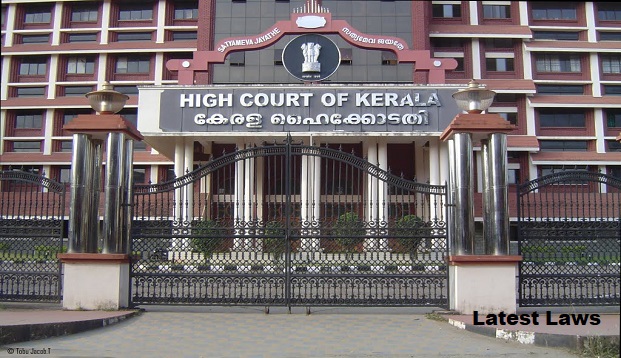
The Kerala High court recently comprising of a bench of Chief Justice Mr.S.Manikumar & Justice Shaji P.Chaly remarked that being A Court Of Record, High Court Can Review Its Own Judgments Under Article 226 Of the Constitution. (Pottakalathil Ramakrishnan v. Thahsildar, Tirur and Others )
Facts of the Case
The original writ petitioner who was the landowner, moved to the court of records seeking direction to the original respondents to collect the land tax and the learned single Judge passed an order in favour of the original writ petitioner. When the original respondents did not comply with the order, civil contempt proceedings were initiated. When the contempt case was pending, the original respondents filed a review petition before the Honourable Court claiming that the original petitioners have suppressed material facts. The same was seen true by the learned single judge and allowed the review petition by passing an order.
The instant writ appeal was filed challenging this order allowing the review petition and the appellant/original petitioners have challenged the validity of the aforesaid order.
Contention of the Parties
Referring to Section 141 of the Code of Civil Procedure, 1908, learned counsel for the appellant argued that the procedure provided in the Code in regard to suit shall be followed, to the extent that it can be made applicable, in all proceedings in any Court of civil jurisdiction, excluding any proceedings under Article 226 of the Constitution of India, and that, as a result, the review petition filed by the responsible party should be dismissed.
The original respondents stressed on the effect of original petitioners suppressing the material facts leading to the filing of a review petition by the original respondents
Courts Observation & Judgment
“It is apparent that these constitutional courts, being courts of record, the authority to recall their own orders is inherent by virtue of the fact that they are superior courts of record,” the Single Judge had noted in allowing the review petition, citing Shivdeo Singh and other decisions. “This has been acknowledged in numerous of our decisions. The Writ Petition was filed under Article 226 of the Indian Constitution by the petitioner. Based on the evidence presented by the review petitioner, I believe the writ petitioner has not come to this Court with clean hands. Material facts were withheld in the Writ Petition, as can be shown. As a result, I believe it is necessary to examine and recall.”
The bench further stated that a High Court did not need to look for another law other than Article 226 that permitted it to examine its own decisions. The Court agreed that the evidence showed that the appellant had concealed significant facts, based on the circumstances.
The court stated, “Though various contentions were raised by the appellant to substantiate that there is no power to review the judgment passed in a writ petition, we are unable to accept the same, for the reason that it is well settled proposition in law that being a Court of record, the High Court is vested with powers to proceed under Article 226 of the Constitution of India itself and review a judgment, if it is found that there was material suppression, and the Court was not right in granting a verdict in favour of the writ petitioner due to suppression of material facts.”
The Court while rejecting the appeal emphasized a point about the need of approaching the Court “with clean hands,” meaning without deception. The ruling expressly states that if a litigant fails to come before a court with honesty, he should be sent the door as soon as possible.
The bench remarked, “The honesty, fairness, purity of mind, and approaching the writ court with clean hands should be of the highest order and is a sine qua non to maintain a writ petition and secure orders, failing which the litigant should be shown the exit door at the earliest point of time.
Moreover, suppression is a factor quite strange and alien, and an antithesis to rule of law and fundamental governance of the country, and the tendency of the litigant to suppress material aspects if not eradicated, the resultant quotient would be lack of faith of the citizens in the legal system and the courts of law, and if that is allowed to happen, it would ruin the basic tenets of the democratic system and the rule of law prevailing in this country.
Read Judgment ;
SOURCE ; .latestlaws.com
Social media is young.
Social media raises questions.
Social media is not satisfied with an answer.
Social media looks at the big picture.
Social media is interested in every detail.
social media is curious.
Social media is free.
Social media is irreplaceable.
But never irrelevant.
Social media is you.
(With input from news agency language)
If you like this story, share it with a friend!
We are a non-profit organization. Help us financially to keep our journalism free from government and corporate pressure.











0 Comments